

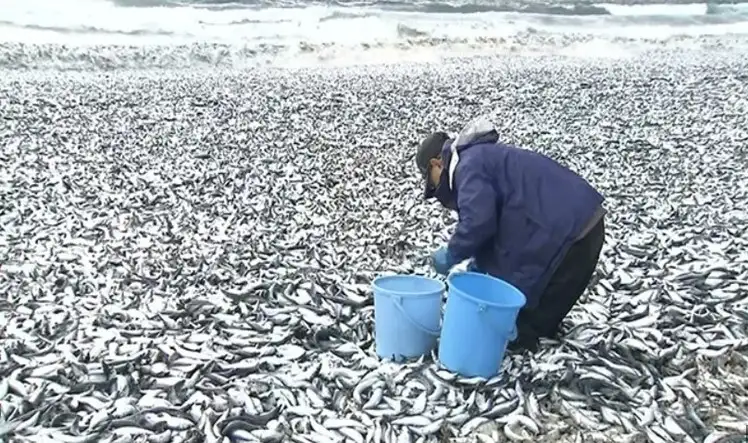
Around 1,000 tons of sardines and mackerels beached on the northern coast of Japan late last week, raising concerns about mass fish deaths due to pollution.
Biologists concluded the fish on the beach in Hakodate, Hokkaido prefecture, died from lack of oxygen in the water under one of two scenarios, according to the Asahi Shimbun. The first hypothesis is that the fish were chased by predators into the shallow bay near Toi village. There, the huge number of fish quickly used up all the available oxygen in the water. The other scenario is that the school of fish suddenly encountered a cold water mass while migrating, weakening them.
The fish started beaching on December 7, leaving a 1.5 km long coastline filled with silver fish carcasses as deep as the knees. Local authorities estimated around 1,000 tons of fish washed ashore but the actual number could be higher.
“At this time of year, large schools of sardines and mackerels migrate southward off the coast of Hokkaido. They are often hunted by larger predators like dolphins and tuna,” said Kevin Short, a naturalist and professor of cultural anthropology at the Tokyo University of Information Sciences. “It appears a large number of fish were herded into the crescent-shaped shallow bay. There, they panicked and quickly used up all the available oxygen with nowhere else to go.”
According to Short, many similar cases have occurred in the past, although such a large number of fish is highly unusual and rare. Previous recorded cases were in Tokyo Bay and the sea between Japan’s main island of Honshu and Shikoku. In those cases, algal blooms were thought to be a contributing factor to the mass deaths. In such instances, drifting microorganisms sink to the seafloor and consume most of the water’s oxygen, making it hard for the fish to survive.
Daisuke Imura, a local official from the Ministry of the Environment, said similar cases have occurred in the prefecture over the past few years but never on such a large scale. According to Imura, it is unclear whether climate change impacted the fish stock, but rising temperatures have had a clear effect on land. This year has seen less snowfall than usual. Local authorities urged people not to eat the beached fish and carried out beach cleanups over the weekend.